Can a local newsroom make money with a paid newsletter?

Yes, a local newsroom can make money with a paid newsletter when reader revenue covers the reporting, production and subscription work required to deliver it. A profitable local newsletter business needs a specific reason to pay—not just local coverage—and a plan that counts staff time alongside software and payment costs. Selling subscriptions brings in revenue; keeping enough of it after expenses is the test.
TL;DR
- A local newsletter business needs a distinct reader promise and subscription revenue that covers its operating costs.
- Choose paid-only, free-plus-paid or membership based on what readers receive and what your team can sustain.
- Count reporting, production, payment processing and subscriber support before calling a paid newsletter profitable.
- Letterhead fits media teams bringing website stories into newsletter production; verify paid-subscription requirements separately.
Can a local newsroom make money with a paid newsletter?
Yes, but start with the product and its costs, not a subscriber target borrowed from another publisher. Your newsroom needs to identify who will pay, what those readers receive and how much work each issue creates.
The business model changes that workload. Choose the reader promise before choosing newsletter software for local news outlets.
| Model | Best for | What readers support | Main advantage | Main constraint |
|---|---|---|---|---|
| Paid-only newsletter | A clearly defined audience with a distinct information need | Access to the newsletter itself | A direct connection between the product and subscription | Readers need enough evidence of value before subscribing |
| Free newsletter with a paid edition | Newsrooms serving both a broad community and a narrower specialist audience | Additional reporting, analysis or utility | Public coverage can remain accessible | Your team must maintain a clear difference between editions |
| Membership with a newsletter benefit | Publishers asking readers to support a wider journalism mission | The newsroom, with the newsletter included | The appeal extends beyond an individual issue | Newsletter revenue is harder to separate from membership revenue |
These are different promises, not interchangeable labels. A membership appeal asks readers to support journalism; a paid newsletter asks them to buy a recurring information product.
Why does the reader promise matter more than the format?
A newsletter is a delivery format. The reason to pay is the work it does for a particular reader: explaining consequential local decisions, organizing difficult-to-follow information or providing reporting they can’t get from your public coverage.
For your 2026 plan, finish this sentence before discussing software: “This newsletter helps this reader understand or do this specific thing.” If the answer is simply “stay informed,” narrow it. Name the reader, the subject and the recurring benefit.
Keep the public-service boundary explicit. Decide which essential reporting remains accessible and what additional work belongs in the paid product. That is an editorial decision as well as a commercial one.
When does a paid-only local newsletter make sense?
A paid-only newsletter fits a focused information need that you can demonstrate before asking for payment. A proposed planning-and-development briefing, for example, needs more than links to public notices: its promise might be explaining decisions, deadlines and consequences.
That is a product concept, not evidence of demand. Talk to the intended readers and show them a sample issue before committing reporting capacity.
The advantage is clarity: subscribers buy a defined publication. The constraint is discovery. Prospective readers need a way to judge the work, whether through a sample, public excerpt or clear description of what an issue contains.
Choose paid-only when the paid publication has a distinct job and your team can keep doing it. Don’t hide an undifferentiated version of your existing public newsletter behind a payment requirement.
When is a free newsletter with a paid edition a better fit?
A free-plus-paid model fits a newsroom that wants broad public access while offering a separate, deeper product. The free newsletter must still serve its readers; it shouldn’t become an extended advertisement for the paid edition.
Write the distinction in concrete terms. A public newsletter might summarize local decisions, while a proposed paid edition explains a specific beat in greater depth. State what additional reporting or organization the paid reader receives.
The benefit is a visible introduction to your journalism. The cost is maintaining distinct promises, even when both editions draw on the same reporting.
Choose free-plus-paid only when you can explain the difference without saying “more content.” If the distinction is unclear to your editors, it will be unclear to readers.
When should the newsletter be part of a membership?
Membership fits a broader appeal: readers support the newsroom’s work, and a newsletter is part of that relationship. The newsletter still needs a useful editorial purpose, but access isn’t necessarily the entire reason someone joins.
The advantage is alignment with a public-service mission. The limitation is financial interpretation. Membership receipts don’t automatically prove that the newsletter would succeed as a standalone subscription.
Keep the accounting honest in your 2026 budget. Separate revenue from newsletter-only subscriptions, where they exist, from revenue supporting a broader membership package. Describe any internal allocation as an allocation, not a measured sale of the newsletter.
Why does paid newsletter profitability vary?
Profitability changes with the promise, workload and revenue arrangements—not merely the size of your email list. Review these factors together:
- Reporting requirements: Original reporting, document review and specialist analysis create different workloads from curating existing stories.
- Publishing commitment: Every promised issue requires production and editorial attention, including during leave and busy news periods.
- Audience overlap: Existing website readers provide a place to introduce the product, but readership isn’t proof of willingness to pay.
- Subscription operations: Payment questions, access problems, cancellations and renewals need an owner.
- Revenue deductions: Processing charges, refunds and any platform charges affect what the newsroom retains.
- Shared resources: Existing reporting can support an issue, but editing and production time still belong in the calculation.
A larger audience doesn’t resolve an expensive or unclear product. A smaller, focused audience doesn’t remove the need to cover costs either.
How do you calculate whether the newsletter can support itself?
Start with money retained, then subtract the full cost of publishing. Keep your actual figures separate from assumptions so a forecast doesn’t become a claim about performance.
Newsletter operating result = subscription receipts minus revenue deductions minus reporting, production and operating costs.
Use this worksheet for your 2026 budget. Fill it with payroll records, supplier terms and your own publishing plan rather than industry averages.
| Worksheet field | What to enter | What not to overlook |
|---|---|---|
| Subscription receipts | Reader payments received during the reporting period | Revenue from a broader membership package needs separate treatment |
| Revenue deductions | Processing charges, refunds and applicable platform charges | Gross receipts aren’t retained revenue |
| Reporting and editing | Staff or freelance work assigned to the product | Existing employees still spend time on the newsletter |
| Issue production | Curation, assembly, review and publication work | Reusing stories doesn’t eliminate production |
| Subscriber operations | Payment, account and cancellation support | Assign responsibility rather than assuming someone will handle it |
| Shared costs | A documented allocation of relevant operating expenses | Use the same allocation method across reporting periods |
| Operating result | Retained revenue minus the costs above | A positive result depends on which costs you included |
How should you count existing staff time?
Record the work even if launching the newsletter doesn’t immediately increase payroll. Time assigned to a paid edition is time unavailable for another reporting or publishing task.
Keep a separate view of additional cash expenses if that helps you make a launch decision. Just don’t label a cash-only surplus as proof that the product covers its full workload.
How should you handle annual subscriptions?
Separate cash received from the publishing commitment attached to it. An annual payment helps fund current operations, but it also commits your newsroom to future issues under the terms you offered.
Use consistent reporting periods. Comparing annual receipts with only a short stretch of production costs gives you an incomplete picture.
How can you test demand before committing the newsroom?
Use a bounded pilot with a clear editorial promise and a written decision rule. The purpose is to test whether readers value the product enough to support the work—not to collect compliments about the idea.
- Define the reader. Identify the local audience and the recurring information problem you intend to solve. Avoid combining unrelated audiences to make the market look larger.
- Write the promise. Describe what an issue includes, what it excludes and when readers should expect it. Make the commitment something your newsroom can sustain.
- Build a sample. Create an issue using the reporting and production process you expect to use. Label demonstration material clearly.
- Test the commitment. Ask intended readers to evaluate the actual offer. Distinguish expressions of interest from completed subscriptions.
- Review the result. Compare revenue, workload and reader responses with the decision rule. Continue, revise or stop based on that evidence.
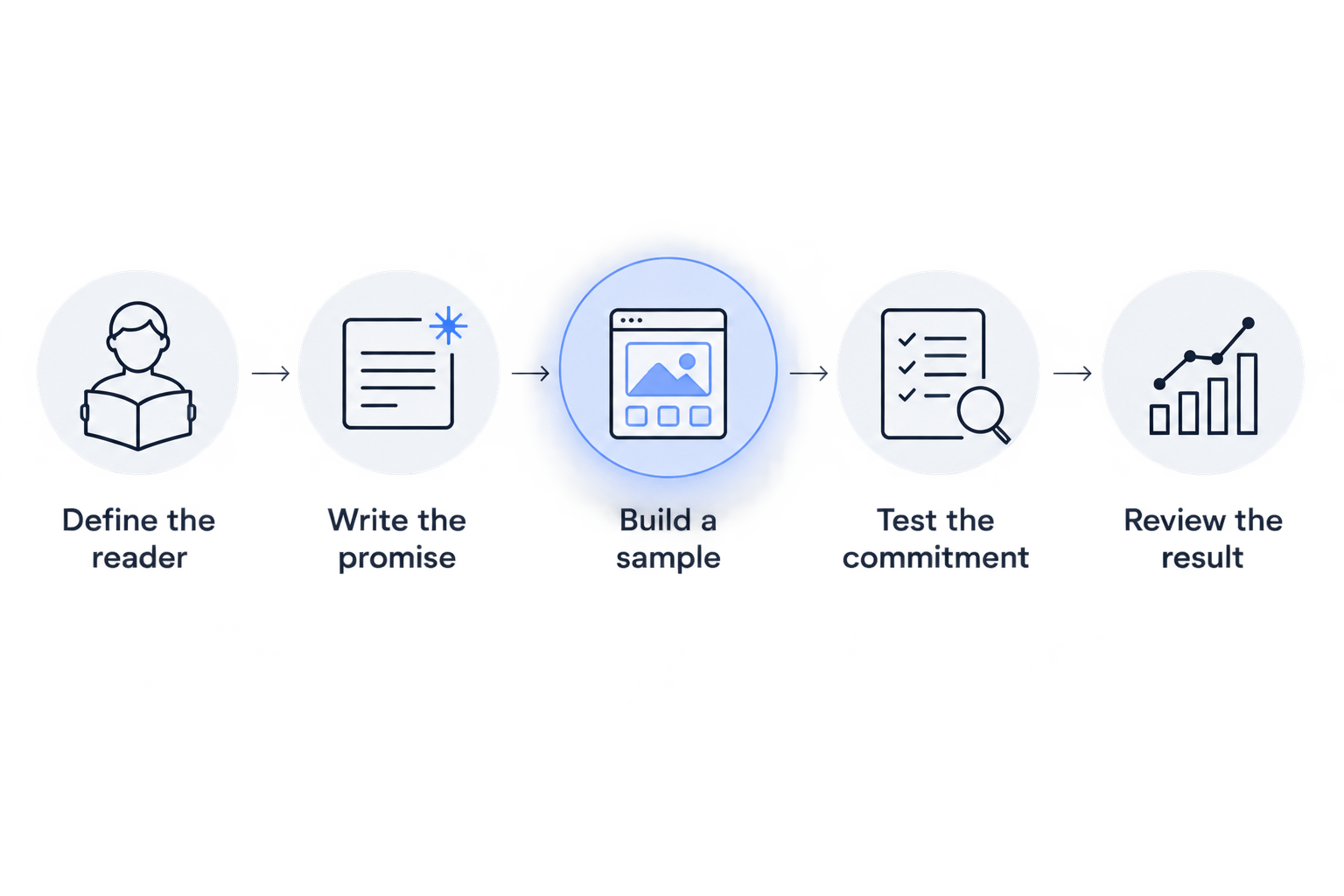
Test the actual reader promise and production workload, not just enthusiasm for the idea.
Write the decision rule before launching the pilot. Name the evidence that would justify continued investment, the workload your team can accept and who makes the decision. Otherwise, a pilot can continue without resolving the business question.
What should you measure after launch?
Your 2026 review should connect reader behavior to the product’s financial result. Avoid treating a growing contact list as a substitute for paying readers or retained revenue.
Keep a recurring record of subscription receipts, deductions, cancellations, renewals and production time. Read cancellation feedback alongside those figures: an unclear promise calls for a different response from an unsustainable publishing commitment.
Also record whether each issue delivered what you promised. That editorial check gives financial results context. A missed commitment isn’t explained away by a successful promotional campaign.
Where does Letterhead fit in a paid newsletter business?
Letterhead is best for media teams that already publish on a website and need one place to run their newsletters. Letterhead brings website stories into the curations library through RSS, the API and the WordPress plugin, and supports newsletter goals, checks before each send and promotions across a portfolio.
That addresses production work; it doesn’t replace the business case. Verify payment collection, paid-access enforcement and subscription-accounting requirements separately before committing to a paid product. Don’t assume that a newsletter production platform covers every subscription requirement.
Teams running 2–5 newsletters are a stated fit. Active-contact counting also matters across a portfolio: a reader subscribed to 3 newsletters counts as 1 active contact, provided at least one subscription is marked subscribed. Unsubscribed, cleaned, disengaged and contacts without subscriptions don’t count.
Can a small local audience support a paid newsletter?
A small local audience can support a paid newsletter only when retained reader revenue covers the product’s costs. There isn’t a universal subscriber minimum: the answer depends on your actual offer, expenses and workload.
Don’t substitute the town’s population or your website audience for evidence of payment. Test the specific publication with its intended readers.
Should you sell sponsorships as well as subscriptions?
Use sponsorship only if it fits the reader promise and your newsroom’s editorial policies. It introduces sales and fulfillment work alongside another source of revenue.
Keep sponsorship and subscription revenue separate in your reporting. That lets you see whether readers support the paid product itself or whether the business depends on a mixed model.
FAQ
Can I start a local newsletter business with an existing newsroom?
Yes, an existing newsroom can build a local newsletter business around its reporting, but the paid product still needs a distinct reader promise. Count the editing, production and subscription work even when existing staff handle it.
How many paying subscribers do I need for a profitable local newsletter?
Your required subscriber count depends on retained subscription revenue and the full cost of publishing. Calculate it from your own terms and expenses rather than borrowing another publisher’s target.
Should my local newsletter be free or paid?
Choose based on the job the newsletter does and who benefits from it. Keep a public-service edition accessible if that serves your mission, and charge for a clearly defined additional product rather than an unclear promise of more content.
Can I turn my existing free newsletter into a paid newsletter?
You can change the offer, but existing free subscriptions don’t establish willingness to pay. Explain the new promise clearly and test demand before budgeting on subscription revenue.
Does Letterhead handle every part of a paid newsletter business?
Letterhead supports newsletter production, newsletter goals, checks before sends and portfolio promotions. Verify payment collection, paid access and subscription-accounting requirements separately; don’t assume coverage of those functions.
How do I know whether a paid newsletter pilot worked?
A pilot works when its results meet the decision rule you set for reader commitment, retained revenue and production workload. Expressions of interest alone don’t demonstrate a sustainable paid product.
What’s the last decision to make before launching?
Decide what you will stop doing to make room for the paid newsletter. If the answer is nothing, put the additional work into the budget rather than assuming the team will absorb it.
A subscription creates a recurring promise. Build a local newsletter business your newsroom can keep publishing—not just launch.
Related guides
By Letterhead