How much does newsletter sponsorship pay per issue in 2026?

Newsletter sponsorship per issue pays the amount your booking agreement earns: a flat fee, an audience-based payment or a payment tied to a defined action. There’s no universal payout, and the amount you keep also depends on commissions, production costs and any replacement placement you owe if the booking falls short.
TL;DR
- Newsletter sponsorship per issue has no fixed payout; the payment model and booking terms determine earnings.
- Flat fees make booked revenue clear; CPM and CPC require an agreed measurement method.
- Letterhead fits website-based publishing teams managing several newsletters, not publishers looking for a guaranteed sponsorship payout.
- Calculate net earnings after commissions, production costs and any make-good obligations.
How much does newsletter sponsorship pay per issue in 2026?
An issue earns what the sponsor agreed to buy, not what your subscriber count alone suggests. Start with the payment model, then apply the measurement and settlement terms in the agreement.
A rate card is your asking price. A signed booking is a commitment under stated conditions. Neither is automatically the same as cash collected or profit.
| Payment model | How you calculate issue revenue | Best for | Main advantage | Main limitation |
|---|---|---|---|---|
| Flat fee | Agreed fee for the specified placement | A clearly defined issue and placement | You know the booked amount before sending | Scope changes and extra work can reduce your margin |
| CPM | Agreed audience count divided by 1,000, multiplied by the CPM | Bookings with a clearly defined audience measure | Payment follows the agreed audience basis | Different counting methods produce different results |
| CPC | Qualifying clicks multiplied by the agreed payment per click | Sponsors buying measurable visits | The bill follows a defined action | Your earnings depend on click volume and filtering rules |
CPM means cost per thousand. CPC means cost per click. These are billing methods, not evidence that one newsletter should earn the same amount as another.
For a 2026 booking, put the calculation beside the placement description. That gives both parties something specific to approve before the issue goes out.
Why does the payment definition matter?
A sponsor can buy space in your newsletter without buying a promised business result. Keep that distinction clear in the proposal and the report.
An impression, a click and a purchase are different events. If the sponsor wants to examine what happens after a reader reaches its website, agree on campaign tags and analytics access separately; this guide to tracking newsletter performance in Google Analytics explains that measurement layer.
Don’t let an undefined outcome become a payment condition after the send. If payment depends on an action, name that action in the booking.
How does a flat-fee newsletter sponsorship pay?
A flat-fee sponsorship pays the agreed amount for a defined placement. Specify the newsletter, issue date, position, creative requirements and any exclusivity rather than selling an unspecified mention.
Best for: a booking where both parties want a known commitment before publication. The benefit is clarity: you can plan around the booked fee without waiting for clicks to settle.
The limit is scope. Writing sponsor copy, sourcing artwork, handling repeated revisions and adding another placement are separate pieces of work unless you include them explicitly.
Use this booking language as a starting point:
Payment covers the named placement in the agreed issue. Creative requirements, approval deadlines, reporting and any replacement obligations are defined below.
This is a suggested template, not a customer quote. Complete the terms rather than treating the wording as a finished contract.
How does CPM newsletter sponsorship pay?
CPM sponsorship revenue equals the agreed audience count divided by 1,000, multiplied by the agreed CPM. The important question is what qualifies for that audience count.
A subscriber total, a delivered-message total and a measured-open total are not interchangeable. Your agreement needs to identify the specific measure used for billing, the reporting source and when the count becomes final.
Best for: a sponsor and publisher that agree on the audience measure before booking. CPM provides a consistent calculation when that definition stays fixed.
The limitation is measurement disagreement. A proposal based on the full list and an invoice based on another measure describe different purchases, even when both use the same CPM.
Put the audience basis immediately beside the formula. Don’t bury it in a separate document that the buyer hasn’t approved.
How does CPC newsletter sponsorship pay?
CPC sponsorship revenue equals qualifying clicks multiplied by the agreed payment per click. Define a qualifying click before accepting the booking.
The agreement should state whether repeated clicks count, how automated activity is handled, which report settles the bill and when measurement closes. Otherwise, the same send can produce competing totals.
Best for: a booking explicitly focused on measurable visits. CPC connects payment to an action rather than simply reserving space.
The limitation is that your issue’s inventory is committed while the final payment remains unsettled. You also need to separate your responsibility for the placement from the sponsor’s responsibility for its destination page and offer.
Don’t accept a click-based agreement using a flat-fee forecast. They carry different payment conditions.
Why does newsletter sponsorship revenue vary?
Compare the actual booking terms before comparing headline earnings. These factors explain what changes in the calculation or the work attached to it:
- Audience basis: The agreed billable audience determines the calculation for an audience-based booking.
- Placement scope: Position, creative format and exclusivity define what the sponsor receives.
- Payment model: Flat fees, CPM and CPC settle against different conditions.
- Included work: Copywriting, revisions and reporting take time that belongs in your margin calculation.
- Intermediary terms: A sales representative or network commission changes what you retain.
- Make-good obligations: A make-good is a replacement placement or other remedy for a missed contractual requirement. It uses inventory or work beyond the original issue.
For your 2026 rate card, separate those terms instead of presenting one number with no explanation. A buyer should be able to tell what is included without reconstructing the deal from an email thread.
How do you calculate what you keep from each issue?
Use a booking record that follows the placement from agreement to settlement. Keep the original terms visible when you enter the final results.
- Define placement. Record the newsletter, issue date, position and creative scope.
- Agree measurement. Name the payment model, billable event, reporting source and settlement date.
- Record deductions. Include commissions, direct production expenses and any agreed credits.
- Reconcile payment. Compare earned revenue, invoiced revenue and collected payment.
- Review margin. Record the work and inventory used, including any replacement placement.
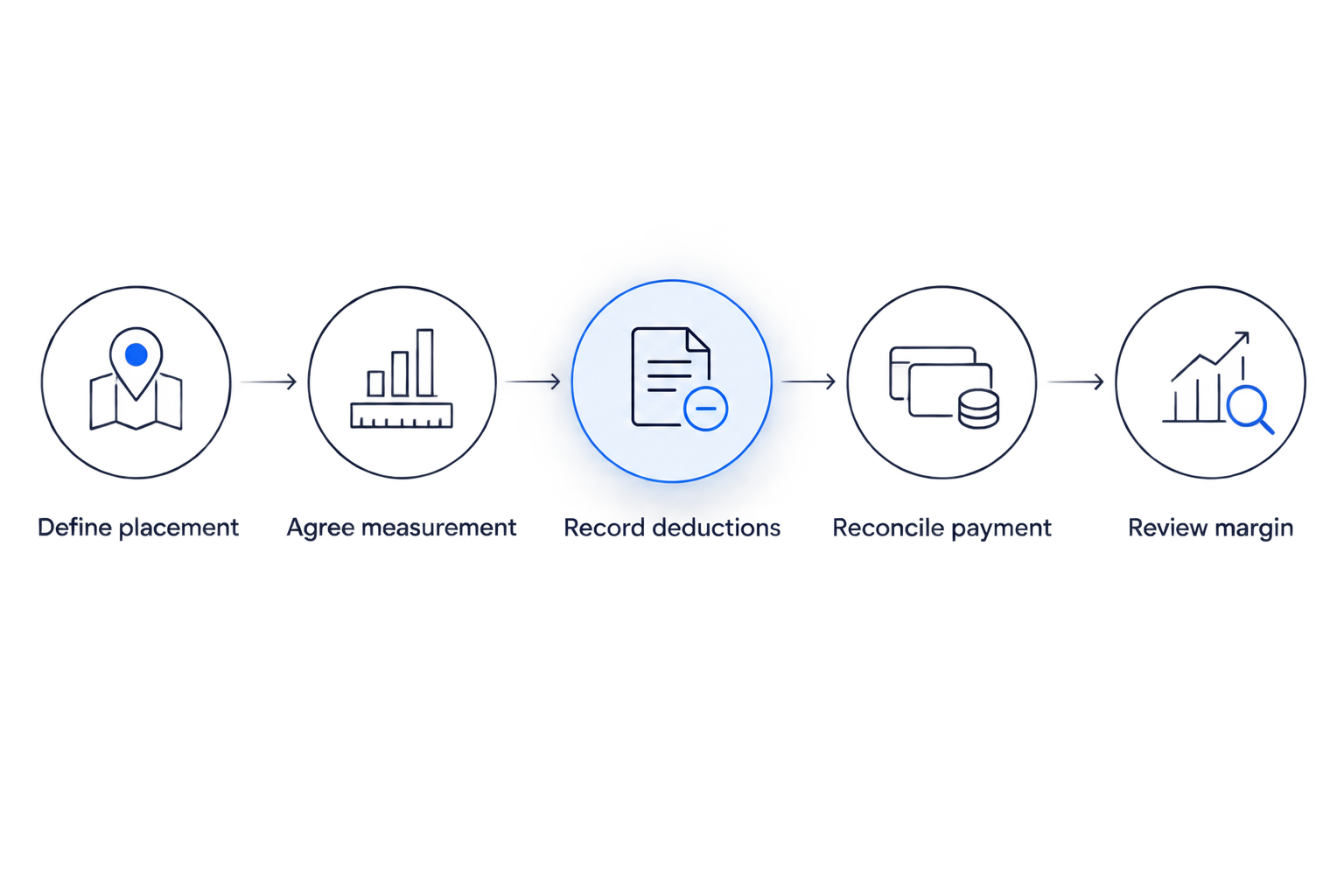
Agree on the calculation before you reserve the placement.
Keep cash contribution and fully costed profit separate. Cash contribution subtracts direct cash expenses from earned revenue; a fuller margin calculation also assigns a cost to your team’s work.
Neither calculation should quietly ignore a commission or count an unpaid invoice as collected cash. Choose the measure you need, label it and use it consistently across issues.
What should a sponsorship booking template include?
Copy this specification into your booking document. It works as a checklist for a single issue and as the starting point for a campaign covering several sends.
| Field | What to write down | What it prevents |
|---|---|---|
| Newsletter and issue | Newsletter name and agreed publication date | Confusion about which audience or send was purchased |
| Placement | Position, format and included links | Disagreement about what appeared |
| Creative owner | Who supplies copy and artwork | Unassigned production work |
| Approval deadline | When final approval is due and what happens if it is late | Last-minute scope disputes |
| Payment model | Flat fee, CPM or CPC | Different assumptions about how revenue is earned |
| Measurement basis | Billable event, report source and filtering rules | Competing invoice totals |
| Settlement window | When the measurement period closes | An invoice that cannot be finalized |
| Deductions | Commission and agreed credits | Confusing gross revenue with retained earnings |
| Remedy | The specific circumstances requiring a make-good | Open-ended replacement obligations |
| Payment terms | Invoice timing and payment deadline | Confusing booked revenue with cash received |
The most useful field is the one your last booking left ambiguous. Review the template after a disputed invoice or difficult production cycle, then change the next agreement rather than relying on memory.
For a 2026 portfolio, use the same field names across newsletters. Keep each newsletter’s audience and placement terms distinct; consistency in the document doesn’t mean every issue sells the same thing.
How should a publisher manage sponsorships across newsletters?
Keep the commercial agreement connected to the production work. Your team needs to know which promotion belongs in which issue, who approves it and what the sponsor was promised.
Letterhead gives publishing teams one place to run every newsletter they send, including newsletter goals, checks before each send and promotions across the portfolio. RSS, the API and the WordPress plugin bring website stories into the curations library.
Letterhead is best for media teams that publish on a website and manage several newsletters. Small teams running two to five newsletters are a key fit because the job spans stories, issues and promotions rather than a single isolated send.
The limit matters: a publishing platform doesn’t establish what a sponsor will pay. You still need an agreed placement, a payment model and settlement terms; full-service onboarding and dedicated support are enterprise-only.
Does a bigger subscriber list mean a bigger sponsorship payment?
A bigger list does not automatically mean a bigger payment. Under a flat-fee agreement, the booked fee remains the agreed fee unless the contract says otherwise.
Under CPM, the payment changes only with the agreed billable audience measure. Under CPC, subscriber count is not the billing event; qualifying clicks are.
Can you sell several sponsorship placements in one issue?
You can structure an issue with several placements if the booking terms allow it. Define each position and check that exclusivity promises don’t conflict.
Calculate the issue’s total earned revenue across its bookings, then subtract the associated deductions and costs. Don’t count an unbooked slot as earned revenue.
Is booked sponsorship revenue the same as profit?
Booked sponsorship revenue is not profit. Profit requires accounting for the costs attached to earning that revenue, including the team’s work under your chosen accounting method.
Collected payment is a separate measure again. Keep all three labels visible rather than using “earnings” for every stage.
FAQ
What’s a normal newsletter sponsorship payment per issue?
There is no universal payment per issue. The booking’s payment model, placement scope and measurement terms determine what the publisher earns.
How do I calculate newsletter sponsorship per issue using CPM?
Divide the agreed audience count by 1,000, then multiply by the agreed CPM. Specify the audience measure and report source before the booking is approved.
Is a flat fee better than CPC for newsletter sponsorship?
A flat fee is better for knowing the booked amount before publication; CPC fits an agreement based on qualifying clicks. Neither removes the need to define the placement and settlement terms.
Do sponsors pay for subscribers or opens?
Sponsors pay against the basis specified in the agreement. Subscriber counts, measured opens and qualifying clicks are different measures and should not be substituted after booking.
What should I include in a newsletter sponsorship report?
Report the booked placement and the measurements agreed for that booking. Keep placement delivery and click reporting separate from claims about the sponsor’s sales or conversions.
Can Letterhead tell me what a sponsor will pay?
Letterhead’s publishing capabilities do not establish a sponsor’s payment. Use the booking agreement to define the payment model while your team manages issues, send checks and portfolio promotions.
What’s one last thing to check before accepting a booking?
Read the make-good clause before you celebrate the sale. A replacement placement can occupy an issue you intended to sell separately.
For your next 2026 booking, write down exactly what triggers a remedy and what fulfills it. A clear limit on the obligation is part of knowing what the original issue earns.
Related guides
By Letterhead