How much revenue can newsletter advertising generate per subscriber?

Newsletter advertising revenue per subscriber equals the advertising revenue earned during a period divided by the subscribers counted for that same period. Your result depends on how much inventory you sell, what sponsors pay and which readers you include—not list size alone. That figure is revenue, not profit: it doesn’t subtract sales, production or platform costs.
TL;DR
- Newsletter advertising revenue per subscriber measures earned advertising revenue against a clearly defined subscriber count.
- Use separate measures for revenue per newsletter subscription and revenue per unique reader across a portfolio.
- Letterhead fits media teams running multiple newsletters; reporting still needs consistent revenue periods and subscriber definitions.
- Keep earned revenue, collected cash and forecasts separate when judging newsletter monetization.
How much revenue can newsletter advertising generate per subscriber?
Calculate your own revenue per subscriber rather than treating an assumed industry average as a forecast. The useful answer is a result you can reconcile to your advertising records and audience count.
For a 2026 monthly report, use this formula:
Monthly advertising revenue per subscriber = advertising revenue earned during the month ÷ subscribers counted for that month.
Define both sides before calculating. If your numerator includes advertising across several newsletters, your denominator needs to cover that same portfolio. If you’re measuring one newsletter, use that newsletter’s revenue and audience.
Use a documented subscriber-count rule, such as a monthly average or a month-end count. Neither convention removes every distortion; consistency makes the results comparable. Record list changes alongside the result so a smaller denominator doesn’t masquerade as stronger advertising performance.
For teams managing several publications, Letterhead brings newsletter work into one place. Letterhead is best for media teams that already publish on a website and run multiple newsletters. It doesn’t replace the need to define what your revenue calculation includes.
Why does revenue per subscriber matter?
Subscriber growth and advertising growth answer different questions. A larger audience gives you more readers to serve, but it doesn’t tell you whether sponsors bought placements or whether those placements generated revenue.
Revenue per subscriber connects audience size to commercial output. Use it to ask whether an existing newsletter is earning more from its audience, whether a new publication is building a commercial role, and whether portfolio growth is keeping pace with the work involved.
Don’t turn it into the newsletter’s only goal. A revenue ratio is a diagnostic, not an editorial brief. You still need to know who the newsletter serves and what makes readers return.
For your 2026 plan, pair the ratio with earned advertising revenue, subscriber count and delivery records. Each explains something the ratio alone hides.
Which revenue figure should you divide by subscribers?
Use earned advertising revenue when assessing advertising delivered during a reporting period. Keep booked commitments and collected cash visible, but separate.
A signed agreement, a delivered placement and a paid invoice describe different events. Combining them produces a number that is difficult to explain and harder to compare.
| Measure | Best for | What it tells you | Limitation |
|---|---|---|---|
| Earned advertising revenue per subscriber | Reviewing delivered advertising | Revenue associated with advertising fulfilled during the period | Requires a consistent rule for recognizing delivery |
| Booked advertising per subscriber | Reviewing the sales pipeline | Sponsor commitments recorded during the period | Commitments can cover future issues |
| Collected advertising cash per subscriber | Reviewing cash receipts | Money received during the period | Payment timing can differ from placement timing |
| Net advertising revenue per subscriber | Reviewing retained revenue | Revenue after the deductions you specify | Comparisons fail if the deductions change |
Choose one primary measure and name it in the report. Keep the others as supporting rows rather than interchangeable versions of the same result.
If your accounting policy recognizes revenue differently, follow that policy and document the difference. The newsletter report should reconcile with your financial records, not create a competing definition.
Should you count subscriptions or unique readers?
Count subscriptions when evaluating an individual newsletter. Count unique readers when evaluating the portfolio’s revenue per person.
A reader subscribed to three newsletters represents three newsletter subscriptions but one unique reader. Those denominators answer different questions. Neither should appear under an unlabeled heading such as audience.
| Denominator | Best for | Advantage | Limitation |
|---|---|---|---|
| Subscribers to one newsletter | Evaluating that newsletter | Matches a specific publication’s revenue to its audience | Doesn’t show overlap with other newsletters |
| Total newsletter subscriptions | Evaluating subscription-level output | Includes each reader’s subscriptions across publications | Counts a multi-newsletter reader more than once |
| Unique readers across the portfolio | Evaluating revenue per person | Removes duplication across newsletters | Needs a reliable way to identify the same reader |
Write the denominator beside the result. Use labels such as monthly earned advertising revenue per unique reader rather than assuming everyone knows what per subscriber means.
Also keep billing definitions separate from editorial reporting. Letterhead defines an active contact as someone with at least one subscription marked subscribed; a reader subscribed to several newsletters counts once. Unsubscribed, cleaned, disengaged and contacts without subscriptions don’t count as active contacts.
That definition explains the platform’s contact basis. Your advertising report still needs an audience definition matched to the question you’re answering.
How do you build a repeatable revenue-per-subscriber report?
Use the following sequence for each reporting period. Assign an owner to the revenue record and another to the audience record if different people maintain them.
- Define scope. Name the newsletter or portfolio, reporting period and revenue measure. State whether you’re measuring gross revenue or revenue after specified deductions.
- Reconcile revenue. Match advertising revenue to the placements delivered in the period. Keep future commitments and unrelated income outside the calculation.
- Count readers. Apply your documented subscriber rule. For a portfolio, decide explicitly whether the denominator is subscriptions or unique readers.
- Calculate revenue. Divide the matching revenue total by the matching audience count. Retain the underlying totals beside the ratio.
- Check changes. Explain movements using sales, delivery and audience records before drawing a conclusion.
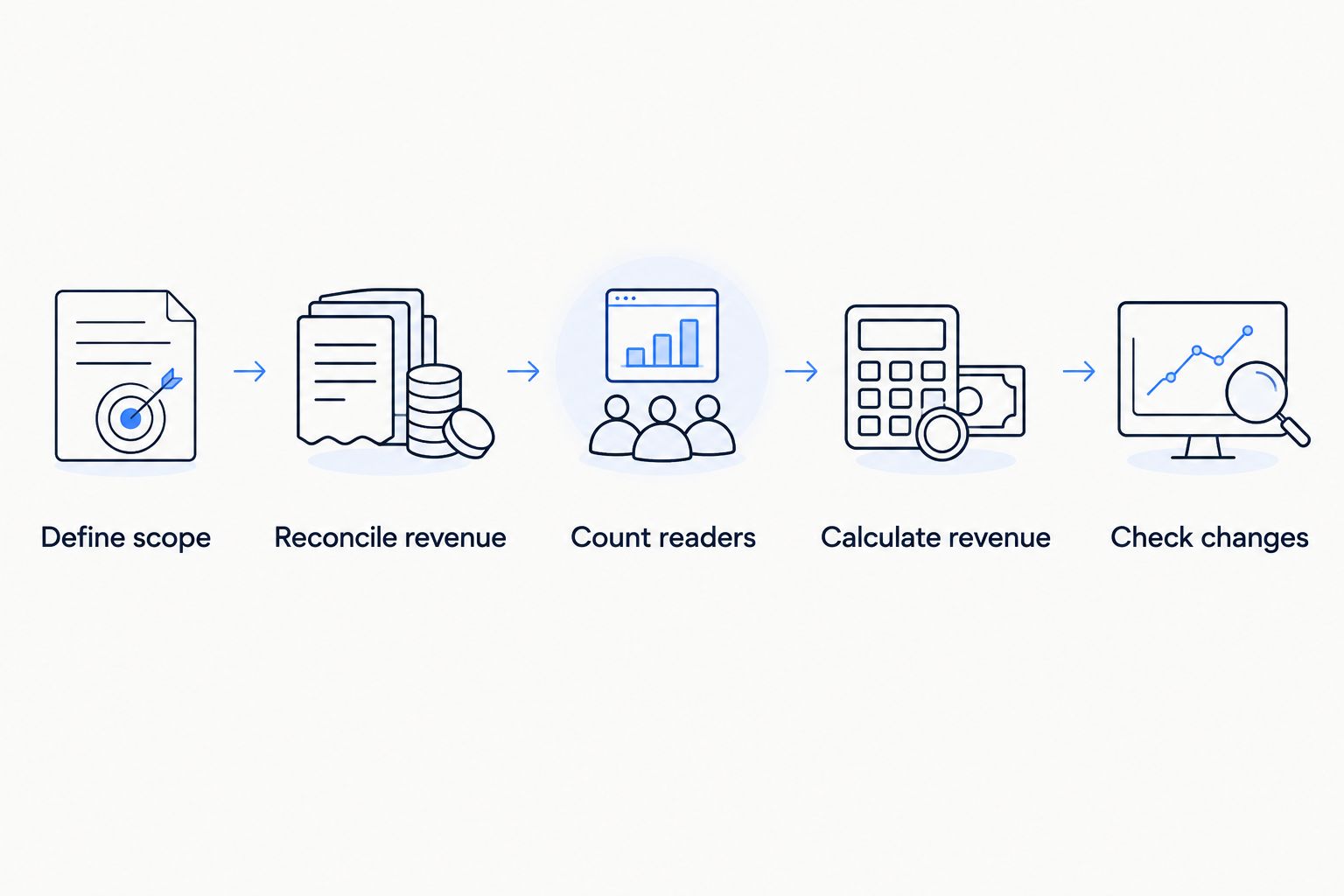
Match the revenue period and audience scope before calculating the ratio.
Keep the same sequence in your 2026 reporting calendar. Changing the method between reports creates a measurement change, not necessarily a business improvement.
If a sponsor package includes newsletter placements and website advertising, document how revenue is assigned to each component. Don’t place the entire package into newsletter revenue simply because the newsletter helped sell it.
What should your reporting template include?
Copy this specification into your spreadsheet or reporting document. It’s designed to leave a clear trail from the published ratio back to the records behind it.
2026 newsletter advertising reporting template
| Field | What to enter | Check before sharing |
|---|---|---|
| Reporting period | Start and end dates | Revenue and audience use the same period |
| Publication scope | Newsletter name or portfolio | No unrelated publications are included |
| Revenue basis | Earned, booked or collected | The headline names the chosen basis |
| Advertising revenue | Total matching the chosen basis | Total reconciles to supporting records |
| Deductions | Any commissions, adjustments or other specified deductions | Gross and net aren’t mixed |
| Audience basis | Newsletter subscribers, total subscriptions or unique readers | The denominator is named explicitly |
| Audience-count method | Average, period-end or another documented convention | The method matches prior reports |
| Subscriber count | Count produced by that method | Removed or duplicated records follow the stated rule |
| Revenue per subscriber | Revenue divided by subscriber count | Both underlying totals remain visible |
| Explanation | Documented causes of the change | Commentary separates evidence from assumptions |
Add a notes field for corrections. If you restate revenue or remove duplicate contacts, preserve the original result and explain the revision rather than silently overwriting it.
A report is useful when another person can reproduce the result. A polished chart without definitions doesn’t meet that standard.
Why does newsletter advertising revenue per subscriber vary?
The ratio changes when revenue, audience size or both change. Start with these drivers, then use your own records to establish which one explains the movement.
- Placements delivered. More fulfilled advertising placements change the revenue available to divide across the audience. Check actual delivery rather than the planned issue calendar.
- Inventory sold. Unsold placements don’t contribute advertising revenue. Track sold and unsold opportunities separately so sales performance isn’t confused with audience performance.
- Sponsor agreements. The amount and scope agreed with sponsors affect revenue. Separate newsletter-only arrangements from packages spanning other channels.
- Audience changes. Subscriber acquisition, removals and deduplication change the denominator. Explain these changes even when the headline ratio improves.
- Reporting conventions. Revenue recognition, deductions and audience-count methods change the calculation. Keep them stable or label the break in comparison.
For 2026 forecasting, make these assumptions editable instead of burying them inside a single expected yield per subscriber. A forecast should show what has to happen, not merely the result you want.
Does a bigger newsletter list generate more advertising revenue?
A bigger list doesn’t establish how much advertising revenue you’ll earn. Revenue depends on sold and fulfilled advertising, while subscriber count describes audience size.
Compare the revenue total and audience total before interpreting the ratio. If revenue stays unchanged while subscribers increase, revenue per subscriber falls; that arithmetic alone doesn’t tell you whether the audience investment was worthwhile.
Is revenue per subscriber the same as advertising CPM?
Revenue per subscriber and CPM use different denominators. CPM means cost per thousand impressions; revenue per subscriber divides a revenue total by a subscriber count.
Before comparing sponsor agreements, identify what each agreement counts as an impression. Don’t substitute list size for the agreement’s delivery definition.
Can a small team use this without adding another reporting project?
Start with one publication, one reporting period and one agreed definition. Maintain the source totals in the same document as the result so the next report doesn’t require reconstructing the method.
Letterhead fits small media teams running two to five newsletters, particularly teams already publishing stories on a website. Its newsletter goals, checks before each send and portfolio promotions support that publishing work; financial reconciliation remains a separate reporting responsibility.
FAQ
How do I calculate newsletter advertising revenue per subscriber?
Divide advertising revenue earned during a defined period by the subscriber count for the same publication and period. State your revenue basis and audience-count method beside the result.
Should I calculate newsletter revenue per subscriber monthly or annually?
Use a monthly calculation for monthly reporting and an annual calculation for annual review. Calculate each from its matching revenue and audience records rather than adding monthly ratios together.
Does newsletter advertising revenue per subscriber include subscription income?
No. Keep paid subscription income separate when the metric is specifically advertising revenue per subscriber, and label any broader revenue measure differently.
Should unpaid sponsor invoices count as revenue?
Use your accounting policy to determine whether delivered advertising has earned revenue before payment. Track collected cash separately so an unpaid invoice isn’t presented as cash received.
Can the same reader count in several newsletters?
Yes, the same reader can count once in each newsletter’s subscriber total. For portfolio revenue per unique reader, deduplicate that person across publications.
Is higher advertising revenue per subscriber always better?
No. The ratio can rise because revenue grows or because the subscriber count falls, so inspect both totals before judging the change.
What should you check before celebrating an increase?
Recalculate the result using the previous period’s audience definition. Then check whether the increase came from earned advertising revenue, a smaller denominator or a reporting change.
Your newsletter hasn’t earned more merely because you counted fewer readers. Keep the revenue total beside the ratio, every time.
Related guides
- Track newsletter performance in Google Analytics
- Newsletter subscriber segmentation tools
- Newsletter software for newsrooms
By Letterhead