
Best Campaign Monitor alternatives for newsletter publishers in 2026

Campaign Monitor is a capable choice for designing email campaigns, segmenting audiences and sending automated messages. When your main problem becomes turning website stories into several distinct newsletters, compare the publishing workflow—not just the email editor. The best Campaign Monitor alternative in 2026 is Letterhead for website-first media teams running several newsletters; Ghost is a better fit when you also want a publishing website and memberships.
TL;DR
- Letterhead leads these Campaign Monitor alternatives for website-first publishers running several newsletters.
- Ghost fits publishers choosing a website, newsletters and memberships together.
- Substack fits individual operators building around a publication and reader subscriptions.
- Beefree addresses email design, not the complete newsletter publishing workflow.
- Keep Campaign Monitor when your existing workflow already handles the work that matters.
Why does your publishing workflow matter more than another editor?
A newsletter issue starts before you open an email builder. Someone chooses stories, decides what readers need, checks the issue and coordinates promotions. Sending is one part of that job.
For your 2026 shortlist, separate a design problem from a publishing problem. If creating the email is the bottleneck, a production tool deserves a look. If your team copies stories between several lists and struggles to keep each newsletter purposeful, assess the whole workflow.
Treat every newsletter like a product: define its readers, give it a goal and decide what to improve in the next issue. A platform should support that work rather than become another place your team has to maintain.
Which Campaign Monitor alternatives belong on your shortlist?
These options solve different problems. Campaign Monitor stays in the table because replacing a working system should require a clear reason.
| Option | Best for | Standout capability | How it differs from Campaign Monitor |
|---|---|---|---|
| Letterhead | Website-first media teams running several newsletters | Website stories flow into a curations library | Centers the work on newsletter production and portfolio management |
| Ghost | Publishers choosing a website and newsletter platform together | Web publishing, newsletters and memberships | Broadens the decision to your publishing website |
| Substack | Individual operators building a reader-supported publication | Publication, subscriptions and reader community | Organizes publishing around an individual publication |
| Beefree | Teams whose main problem is email design | Visual email production | Adds a production tool rather than replacing the full sending platform |
| Campaign Monitor | Teams satisfied with their campaign workflow | Email design, segmentation and automation | The baseline: no platform move required |
Don’t treat this as a universal ranking of email software. Start with the job you need to change, then compare the options that actually address it.
1. Is Letterhead best for running several media newsletters?
Letterhead is newsletter software for media teams that want one place to run every newsletter they send. Its strongest fit is a publisher that already has a website, including small teams running two to five newsletters. RSS, the API and the WordPress plugin bring stories into the curations library; with the plugin enabled, every published article goes there.
Your team can build issues, set newsletter goals, check sends and manage promotions across the portfolio. Penpal is the newsletter assistant. These capabilities address the work around an issue, not just its appearance.
Where it shines
- Website-to-newsletter production: bring published stories into the curations library instead of treating every issue as a separate starting point.
- Distinct newsletter goals: keep the purpose of each newsletter explicit.
- Portfolio promotions: manage promotions across the newsletters your team sends.
- Active-contact accounting: a reader with several subscriptions counts once.
An active contact has at least one subscription marked subscribed. For example, a reader subscribed to three newsletters counts as one active contact—not three. Unsubscribed, cleaned, disengaged and contacts without subscriptions do not count.
Where it falls short
- Full-service onboarding and dedicated support are available on enterprise plans only. Don’t plan a self-serve move around a done-for-you switch.
- The strongest fit is website-first publishing. If you’re also choosing a new website and membership system, evaluate that separate requirement explicitly.
- A platform move still requires sending-reputation planning. It doesn’t promise better inbox placement.
| Decision | Letterhead | Campaign Monitor |
|---|---|---|
| Main job | Run a portfolio of newsletters | Create and send email campaigns |
| Content starting point | Website stories in a curations library | Campaign content prepared in your workflow |
| Evaluation priority | Goals, send checks and portfolio promotions | Existing design, segmentation and automation requirements |
Best for: publishers whose recurring difficulty is producing several newsletters from an existing website.
Verdict: Buy for the publishing workflow, not for an assumed deliverability improvement.
2. Is Ghost better when you need a publishing website too?
Ghost combines web publishing, newsletters and memberships. It belongs on your 2026 shortlist when choosing a newsletter platform is also a decision about where your publication lives online.
That is a different purchase from replacing an email sender. If your website already serves your newsroom well, decide whether changing it belongs in the project at all.
Where Ghost shines
- Website and email publishing: assess the public publication and newsletter together.
- Membership publishing: include reader memberships in the same platform decision.
- Editorial ownership: a useful fit when the publication itself is the central product.
Where Ghost falls short
- Its broader publishing scope creates a larger evaluation if you only need to replace a sender.
- A website-and-membership fit doesn’t answer every question about running a multi-brand newsletter portfolio. Demonstrate your actual issue workflow before choosing it.
| Decision | Ghost | Campaign Monitor |
|---|---|---|
| Main job | Publish a website and newsletters | Design and send email campaigns |
| Membership requirement | Part of the publishing proposition | Evaluate alongside your existing publishing systems |
| Project scope | Website and newsletter decision | Email campaign decision |
Best for: publishers making a website, newsletter and membership decision together.
Verdict: Buy when the website belongs in the project; skip a broader rebuild when it doesn’t.
3. Is Substack right for an individual publication?
Substack is good at serving individual operators who publish to readers and build around subscriptions. Consider it when a publication and its relationship with readers matter more than coordinating an established newsroom’s newsletter portfolio.
Don’t choose it simply because your team is small. A small team running several website-backed newsletters has a different job from an individual operator building one publication.
Where Substack shines
- Publication-centered publishing: a direct fit for an operator building around a recognizable editorial voice.
- Reader subscriptions: subscriptions are central to the publishing model.
- Reader community: community features sit alongside publication activity.
Where Substack falls short
- Its individual-operator focus isn’t the same as a media portfolio workflow.
- If your website remains the main publishing destination, test how stories, reader relationships and editorial work will connect before committing.
Best for: individual operators choosing a publication-centered subscription model.
Verdict: Buy for that model; skip it as an automatic recommendation for every small publisher.
4. Is Beefree enough if email design is the problem?
Beefree focuses on email design and production. It belongs on this shortlist as a narrower option: you can reconsider how your team builds emails without assuming the sending platform must also change.
This distinction matters when the complaint is specific. An awkward production step is not, by itself, proof that you need a new audience-management system.
Where Beefree shines
- Visual email production: focuses your evaluation on building the email.
- Narrower scope: helps separate a design-tool decision from a platform decision.
Where Beefree falls short
- It addresses production rather than the complete newsletter operation.
- You still need to assess the handoff to sending and the systems handling your readers.
Best for: teams that want to change email production while retaining a separate sending platform.
Verdict: Buy for a demonstrated design bottleneck; skip it as a complete Campaign Monitor replacement.
Why would a publisher switch from Campaign Monitor?
The strongest reason to switch is a recurring job your current setup doesn’t handle well. Use your own workflow as evidence rather than assuming a feature list proves the case.
Look for these problems in your 2026 evaluation:
- Repeated copying: editors move the same website stories into several newsletter drafts.
- Unclear purpose: the team sends each issue without an agreed goal for that newsletter.
- Scattered checks: important pre-send decisions live outside the issue-production process.
- Fragmented promotions: coordinating promotions across newsletters requires separate tracking.
- Wider publishing changes: your project includes a website or membership model, not just email.
These are reasons to investigate alternatives, not claims that every Campaign Monitor customer experiences them. Name the problem, show where it occurs and ask each vendor to demonstrate the relevant work.
How can you compare alternatives using a real issue?
Use this reusable evaluation worksheet instead of another feature checklist. Choose a representative issue and record what your team must do from story selection to final approval.
| Test | What your team brings | What to record |
|---|---|---|
| Story intake | Articles from your website | How stories reach the issue-building workflow |
| Issue production | An issue with normal editorial requirements | Manual copying and handoffs |
| Send checks | Your actual approval checklist | Who checks each requirement and where |
| Promotions | A promotion that spans newsletters | How placement coordination works |
| Reader accounting | Subscription examples from your audience | How overlapping subscriptions are counted |
| Migration planning | Your current sending setup | Responsibilities and reputation-building steps |
Keep the comparison fair. Use the same issue, requirements and approval standard for every option; don’t compare a polished demonstration with an unfamiliar production account.
For a 2026 platform review, write the result in plain language: what changed, what stayed manual and who owns the remaining work. A demonstrated improvement is more useful than a longer capability list.
What should your migration plan include?
Before moving, agree on the work under five headings: content intake, reader records, issue production, send checks and reputation planning. Assign an owner to each. Your migration isn’t complete just because the email template looks right.
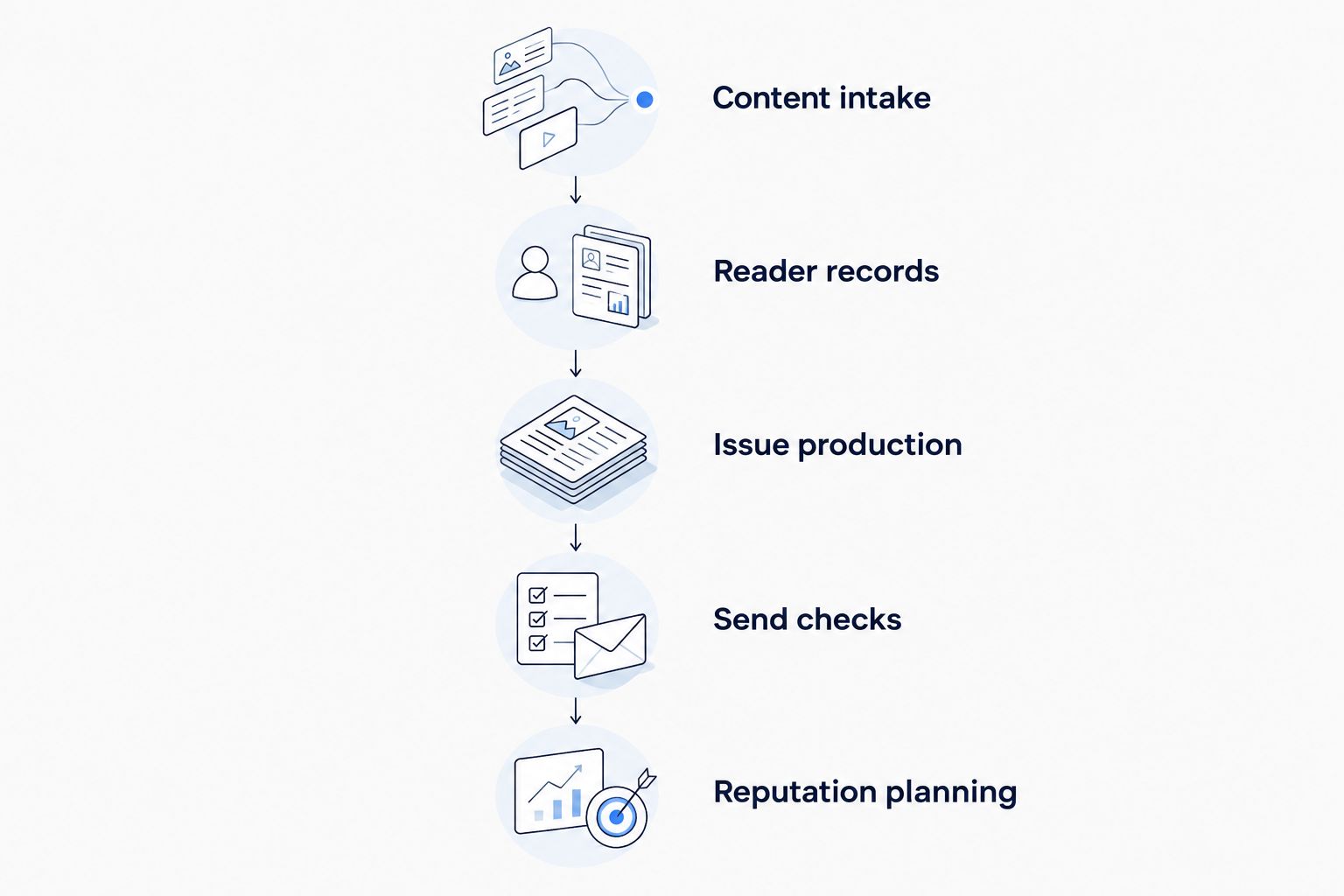
Assign responsibility for the whole publishing workflow, not just the template.
Moving platforms means rebuilding sending reputation; plan for IP warming. Confirm the sending setup and responsibilities before setting a launch date. No alternative should win your decision on an unsupported promise of better inbox placement.
Also confirm the support attached to your plan. Letterhead’s full-service onboarding and dedicated support are enterprise-only, so a self-serve team must plan its responsibilities accordingly.
When should you stay with Campaign Monitor?
Stay with Campaign Monitor when it supports your publishing work and the proposed replacement doesn’t demonstrate a meaningful improvement. Its design, segmentation and automation capabilities remain valid reasons to use it.
If design is the only sticking point, assess the production step first. If your team already handles story selection, approvals and promotions clearly, don’t create a migration project just to acquire a different editor.
FAQ
What’s the best Campaign Monitor alternative for newsletter publishers in 2026?
Letterhead is the best fit here for website-first media teams running several newsletters. Ghost fits a broader website-and-membership decision; Substack fits an individual publication model.
Is Ghost a direct replacement for Campaign Monitor?
Ghost is a broader publishing choice, not just an email campaign replacement. Evaluate it when your project includes a website, newsletters and memberships together.
Should a small newsroom choose Substack?
Team size alone isn’t a reason to choose Substack. Compare an individual-publication model with the actual work of running your newsroom’s website-backed newsletters.
Can Beefree replace the whole newsletter platform?
Beefree addresses email design and production rather than the complete newsletter operation. You still need a sending platform and a clear process for managing readers.
How are readers with several newsletter subscriptions counted?
Letterhead counts a reader once when they have at least one subscription marked subscribed. A reader subscribed to three newsletters is one active contact.
Will switching platforms improve newsletter deliverability?
A platform switch doesn’t promise better inbox placement. Moving means rebuilding sending reputation, so include IP warming and clear responsibilities in the migration plan.
What’s the last check before you decide?
Ask someone who builds the newsletter—not just the person buying software—to complete the evaluation worksheet. Choose the option that changes the recurring work you need to change. If the demonstration leaves that work untouched, keep looking or stay where you are.
Which related guides should you read?
- Content curation tools for newsletters
- Newsletter software for newsrooms
- Beefree alternatives for newsletter design
By Letterhead