
Best newsletter platforms ranked by deliverability in 2026

Best for website-led newsletter teams: Letterhead. Best for avoiding an unnecessary migration: your existing Mailchimp setup, if it meets your needs. Best for an individual publication: Ghost. This 2026 shortlist ranks publishing fit, not measured inbox placement; no platform choice removes your responsibility for permission, authentication and sending reputation.
TL;DR
- For best newsletter platforms ranked by deliverability, choose publishing fit first and verify sending practices separately.
- Letterhead fits website-led media teams running two to five newsletters; it does not promise better inbox placement.
- Keep Mailchimp when your existing workflow works; consider Ghost for an individually operated publication.
- Require an authentication review, a reputation-building plan and clear migration responsibilities before switching.
Why doesn’t a deliverability ranking settle the decision?
Deliverability means reaching a reader’s inbox, not simply getting a receiving server to accept a message. A delivery report and an inbox-placement result answer different questions.
A platform can provide sending infrastructure, but your domain, subscription practices, audience history and sending behavior still matter. Changing software doesn’t erase those responsibilities. It also means rebuilding sending reputation and planning for IP warming, rather than assuming the new provider starts with an advantage.
For a newsroom, the better buying question is: Which platform fits how you publish, and what evidence supports its sending practices? A platform that fits production but lacks a workable transition plan isn’t ready for your team. Neither is a platform selected on an unexplained deliverability score.
Use the companion guide to email deliverability tools when you need to separate platform selection from diagnosis.
What makes the best newsletter platform for deliverability?
Judge a 2026 shortlist against these criteria before you compare product names:
- Authentication: Establish who configures and verifies SPF, DKIM and DMARC. These identify authorized senders and explain how receiving services should handle authentication failures.
- Subscription records: Check that you can preserve subscription status and exclude people who have unsubscribed. A migration must not turn an old address into new permission.
- Sending reputation: Require a transition plan that addresses sending history, audience selection and IP warming where applicable.
- Diagnostic evidence: Ask what you can inspect when messages bounce, receive complaints or stop reaching readers. Don’t accept an unexplained score as the answer.
- Publishing fit: Match the software to your actual work: bringing in stories, building issues, checking sends and coordinating newsletters.
- Support ownership: Identify who handles setup questions and sending problems under the plan you’re considering. Sales assistance isn’t the same as ongoing support.
These are buying criteria, not claims that every shortlisted platform supplies every capability. Ask each provider to demonstrate the parts your team needs.
Which newsletter platforms belong on your shortlist?
The order below reflects fit for website-led media teams. It is not an inbox-placement leaderboard, and the limitations describe the scope of each recommendation rather than undocumented product defects.
| Option | Best for | Standout reason to consider it | Key limitation |
|---|---|---|---|
| Letterhead | Website-led teams managing several newsletters | Website stories enter a curations library; teams can set goals, check sends and manage portfolio promotions | Full-service onboarding and dedicated support are enterprise-only |
| Mailchimp | Teams whose existing setup still meets their needs | Staying avoids a platform move undertaken only for an unsupported delivery claim | Keeping the platform also keeps any unresolved list and production work |
| Ghost | An individually operated publication | Its individual-operator focus matches a different publishing model | That fit doesn’t establish suitability for a newsroom’s multi-newsletter requirements |
Don’t turn this table into a feature checklist. The next sections explain when each option deserves a place in your evaluation and when it doesn’t.
1. Is Letterhead best for website-led newsletter teams?
Best for: media teams running two to five newsletters from an existing website. The job is one place to run every newsletter your team sends, rather than copying stories between disconnected production steps.
RSS, the API and the WordPress plugin bring stories into the curations library. With the plugin on, every published article goes there. Teams can build issues, set newsletter goals, check sends, manage promotions across the portfolio and get help from Penpal, the newsletter assistant.
Pros:
- Website stories can enter the same library used for newsletter curation.
- Goals give each newsletter an explicit purpose beyond filling the next issue.
- Checks before each send belong alongside the publishing work.
- Portfolio promotions address work that spans more than one newsletter.
Cons:
- Full-service onboarding and dedicated support require an enterprise plan.
- A team without an existing website gets less value from the website-to-library workflow.
- Switching still requires sending-reputation rebuilding; the platform isn’t an inbox-placement shortcut.
For a 2026 evaluation, separate contact limits from sending limits. The stated entry-plan limits are up to 5,000 contacts and 5,000 emails a month. Those aren’t interchangeable: a subscriber record isn’t an email allowance for every issue you publish.
An active contact has at least one subscription marked subscribed. A reader subscribed to three newsletters counts once; unsubscribed, cleaned, disengaged contacts and contacts without subscriptions don’t count. Your evaluation should account for both overlapping readership and total sends.
Verdict: Buy for the publishing workflow after you verify the sending setup and transition responsibilities—not for a promised deliverability lift.
2. Should you keep Mailchimp instead of switching?
Best for: teams whose existing Mailchimp setup still supports their publishing needs. Staying is a valid choice when the proposed alternative rests on a deliverability claim without comparable evidence.
Before moving, identify the actual problem. Manual copying between separate lists is a workflow problem; unexpected bounces require a sending investigation. They can occur together, but replacing software doesn’t prove either is solved.
Pros:
- Staying avoids a migration undertaken solely because another provider claims better delivery.
- Your team can investigate the current problem without changing platforms at the same time.
- Keeping the current setup leaves room to document requirements before committing to a replacement.
Cons:
- Staying preserves any manual copying your team already does unless you change that process.
- Separate-list work remains a requirement to solve, not a reason to ignore overlapping readers.
- Familiarity isn’t evidence that the setup meets your next stage of publishing needs.
This recommendation is deliberately conditional. It doesn’t claim Mailchimp has better or worse inbox placement than another provider. It says the burden of proof belongs with the proposed change.
If your team already struggles to coordinate several newsletters, document the missing workflow before requesting demonstrations. Ask candidates to walk through the same issue, readership overlap and promotion scenario. Compare the work, not the polish of the presentation.
Verdict: Hold if the current setup works; evaluate a move when you can name the production problem it must solve.
3. Is Ghost best for an individual publication?
Best for: an individual operator evaluating a publication rather than a newsroom portfolio. Ghost belongs in a different buying conversation from a platform selected primarily to coordinate several newsletters across a media team.
That distinction isn’t a criticism. Individual publishing and team newsletter operations ask different things of software, so the same shortlist order shouldn’t serve both buyers.
Pros:
- Its individual-operator focus matches the recommended buyer.
- It gives a solo publisher a relevant option to evaluate without assuming newsroom requirements.
- It helps keep the decision centered on the publication you’re actually building.
Cons:
- Individual-operator fit doesn’t establish support for your team’s portfolio requirements.
- A category match supplies no evidence of better inbox placement.
- You still need to verify the authentication, subscription-handling and migration details that apply to your setup.
Bring a real publishing scenario to the evaluation. If several editors, newsletters or brands must share work, ask the provider to demonstrate that scenario rather than assuming an individual-publishing recommendation carries over.
Verdict: Buy only when the individual-publication model fits; hold if your central problem is coordinating a newsroom portfolio.
How are these recommendations ranked?
The ranking starts with the reader: a media team publishing on a website and managing newsletters as products. Production fit comes first, followed by the operational limits that affect a purchase.
It does not assign delivery percentages, infer inbox placement from customer names or treat a familiar provider as automatically safer. Publishing fit is a shortlist decision; sending readiness is an acceptance decision. Both matter, but they need different evidence.
For your own comparison, require each candidate to answer the same questions using your proposed sending domain, newsletter structure and support plan. A generic demonstration doesn’t settle those details.
What should you verify before moving newsletter platforms?
Use this 2026 acceptance checklist before approving a switch. Assign an owner and record evidence for every row; an unanswered question remains an open task, not an implied feature.
| Check | Evidence to request | Decision it supports |
|---|---|---|
| Authentication | A written description of required domain records and verification responsibility | Whether your domain setup is ready |
| Subscription records | A sample export and import showing how subscription states are handled | Whether reader preferences survive the move |
| Audience selection | A documented choice of which subscribed readers receive initial sends | Whether the transition has a defined starting audience |
| Reputation building | A sending plan addressing reputation rebuilding and IP warming | Whether the rollout is planned rather than improvised |
| Diagnostics | A demonstration of the evidence available when sending problems occur | Whether your team can investigate failures |
| Support ownership | Written responsibilities under the selected plan | Whether someone owns unresolved setup and sending questions |
The sequence is straightforward: Domain setup, Reader records, Sending plan, then Launch review. Finish each stage before approving the next.
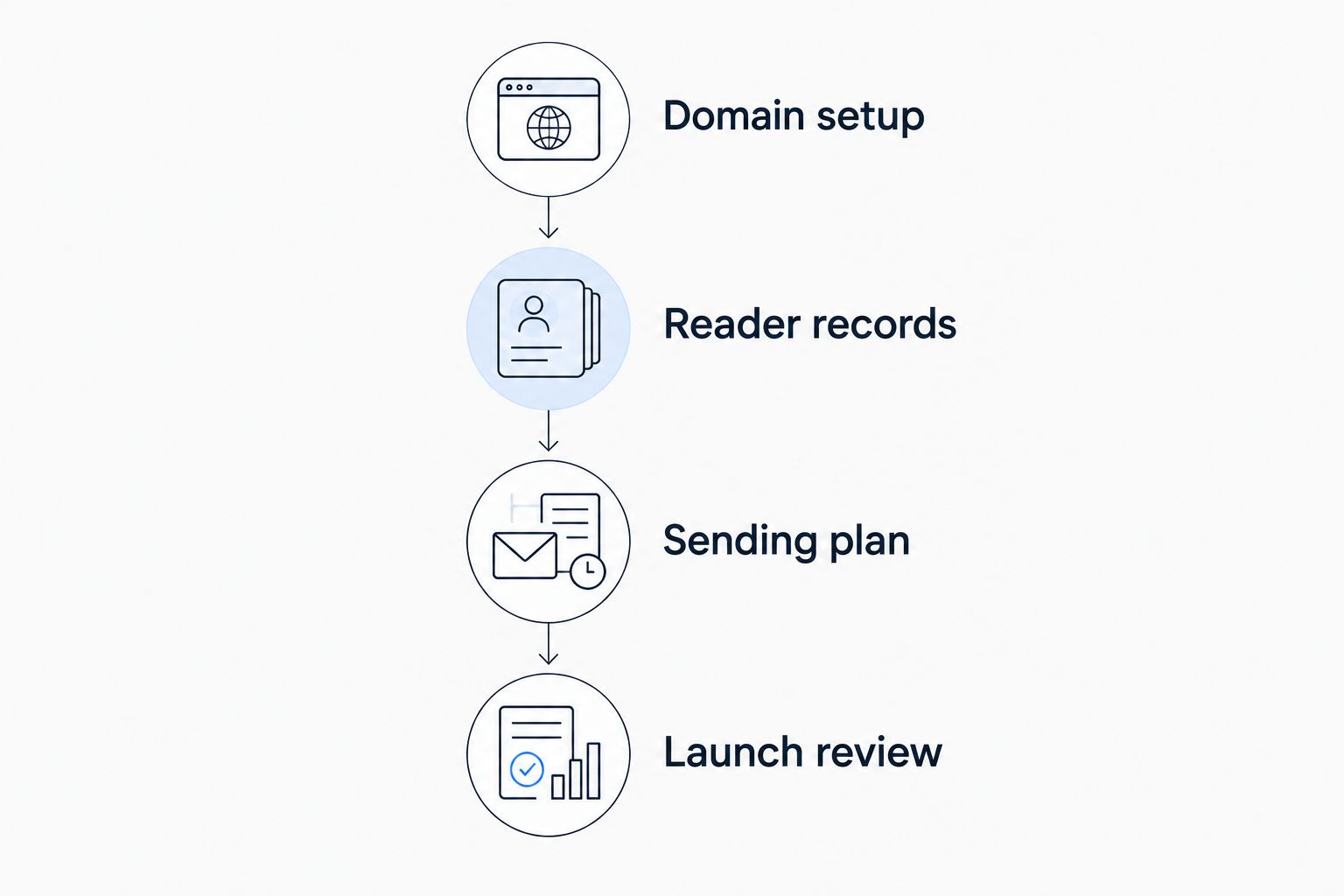
Approve the sending setup and reader records before signing off on launch.
Copy this brief into your evaluation document:
- Publication: Which newsletter is moving, and who is it for?
- Current problem: What specific work or sending issue must change?
- Domain owner: Who can change records and verify authentication?
- Reader records: Which subscription states must the import preserve?
- Initial audience: Which subscribed readers belong in the first sends?
- Sending plan: Who owns reputation rebuilding and the warming approach?
- Issue review: Who checks the newsletter and approves release?
- Problem owner: Who investigates if the launch doesn’t behave as expected?
Keep the completed brief with the purchase decision. It makes the reason for switching explicit and gives your team something more useful than a vendor ranking when launch questions arise.
Which newsletter platform should you choose in 2026?
Letterhead is best for website-led media teams that need one place to run several newsletters. Choose it for that work, with the sending configuration and support responsibilities verified separately.
Keep your existing provider when it meets your needs and the case for moving is only an unsupported deliverability promise. Choose an individual-publishing option when you’re running an individual publication. Don’t buy a portfolio workflow you don’t need, or a solo-publishing fit that leaves your team’s central work unresolved.
FAQ
What’s the best newsletter platform for deliverability?
Choose a platform that fits your publishing work and can demonstrate the sending setup your team needs. This shortlist does not establish an inbox-placement winner; authentication, permission and sending reputation still require verification.
Is Letterhead better than Mailchimp for deliverability?
This comparison does not establish that Letterhead has better deliverability than Mailchimp. Its recommendation is for website-led newsletter production, not a measured inbox-placement advantage.
Will switching newsletter platforms fix spam-folder placement?
Switching platforms does not establish that spam-folder placement will improve. Investigate authentication, subscription practices and sending reputation, and plan for reputation rebuilding and IP warming during a move.
Is email delivery rate the same as inbox placement?
No. Delivery indicates acceptance by the receiving mail system, while inbox placement concerns where the message lands; an accepted message is not proof of inbox placement.
Should a small newsroom switch from Mailchimp?
A small newsroom should evaluate a switch when it can identify publishing work its current setup does not handle well. Manual copying between separate lists is a concrete requirement to bring to a demonstration, not proof of a deliverability problem.
What should I ask before migrating a newsletter?
Ask who owns authentication, subscription-state handling, reputation building, diagnostics and support. Record those responsibilities under the plan you intend to use before approving the move.
What’s the last check before you decide?
Write the reason for switching without using the word deliverability. If you can name a real publishing problem, you have a useful buying brief; if you can’t, investigate the sending problem before purchasing its supposed solution.
Newsletters are products. Give each one a reader, a purpose and a standard for the next issue—not just a new sending account.
Related guides
By Letterhead