
Best newsletter software for trade publications in 2026

Best overall for website-led trade publishers: Letterhead. The best newsletter software for trade publications in 2026 depends on the job: choose Mailchimp for a marketing-led email program, Ghost for a publication-centered website and newsletter, or beehiiv for an independently run newsletter business.
TL;DR
- Letterhead is the best newsletter software for trade publications running several newsletters from an existing website.
- Mailchimp fits marketing-led email programs; Ghost fits website-centered publishing; beehiiv fits independent newsletter operators.
- Compare story intake, reader overlap, send checks and sponsorship work before choosing newsletter software.
- Use an actual issue and overlapping subscriptions to test each platform before committing.
A trade publication needs more than a way to send email. If your editors already publish online and then copy stories into separate newsletters, Letterhead puts story intake, issue building, newsletter goals, send checks and portfolio promotions in one place.
Why does newsletter software matter for trade publications?
A trade newsletter has a specific reader and a specific job. An industry briefing, an association update and a specialist analysis newsletter shouldn’t become interchangeable just because they share a publisher.
Treat each newsletter like a product: define who it’s for, what it helps readers do and what better looks like. Then choose software that supports that work without forcing your editors to rebuild the same issue in several places.
For a small team running two to five newsletters, start with the handoffs. Who selects stories, who checks the issue, and who confirms that a promotion belongs in that newsletter? Those questions make a more useful shortlist than a long feature inventory.
What makes the best newsletter software for trade publications?
Use these criteria before comparing platforms:
- Story intake: Can your team bring published stories into issue production without repeatedly copying them?
- Newsletter identity: Can your team keep a clear reader, purpose and goal for each newsletter?
- Reader overlap: How does the platform handle someone subscribed to several newsletters?
- Production checks: What must your team review before a send, and where does that review happen?
- Commercial workflow: Does the setup match how your team manages promotions and sponsor commitments?
- Scope of change: Are you replacing email software, your publishing website or both?
Don’t give every criterion equal weight. If your website stays, prioritize the route from published story to approved issue. If you’re building a new publication, the website and newsletter relationship deserves more attention.
How do the newsletter platforms compare in 2026?
These recommendations separate different publishing jobs. They aren’t a claim that every platform covers the same requirements.
| Platform | Best for | Standout fit | Key limitation |
|---|---|---|---|
| Letterhead | Website-led trade publishers with several newsletters | Website stories, issue production and portfolio promotions in one place | Full-service onboarding and dedicated support are enterprise-only |
| Mailchimp | Marketing-led email programs | Email campaigns within a broader marketing toolset | Campaign requirements don’t establish a fit for editorial portfolio work |
| Ghost | A publication-centered website and newsletter | Website publishing, memberships and newsletters together | A website-centered decision needs more review if your existing site must stay |
| beehiiv | Independent newsletter businesses | A newsletter-centered publishing platform | Individual-operator fit doesn’t establish fit for a multi-brand publishing team |
The distinction matters: a good tool for an individual publication isn’t automatically the right place to run a portfolio. Likewise, a broad marketing platform isn’t automatically wrong just because your organization publishes editorial content.
1. When is Letterhead the best fit for trade publishers?
Best for: media teams building several newsletters from an existing website.
The platform brings website stories into the curations library through RSS, the API or the WordPress plugin. RSS is a feed of published content; an API lets software exchange information. With the WordPress plugin on, every published article goes into the library.
Your team can build issues, set newsletter goals, check sends and manage promotions across the portfolio. Penpal is the newsletter assistant. Your editors still decide what belongs in an issue and review the work.
Letterhead is best for trade publication teams that already publish online and need one place to run several newsletters.
Pros:
- Website stories can enter the curations library without repeated manual copying.
- Newsletter goals give each publication an explicit purpose.
- Checks before each send belong alongside issue production.
- Promotions can be managed across the portfolio.
Cons:
- Full-service onboarding and dedicated support are limited to enterprise plans.
- A team without an existing publishing website gets less value from the website-to-newsletter workflow.
The active-contact model also deserves a careful check. A contact is active when at least one subscription is marked subscribed; a reader subscribed to three newsletters counts once. Unsubscribed, cleaned, disengaged and contacts without subscriptions don’t count.
The free plan includes up to 5,000 contacts and 5,000 emails a month, with no credit card needed to sign up. Those are separate limits: contacts describe the audience, while emails describe sending volume.
Verdict: Buy for website-led newsletter production; don’t assume enterprise onboarding applies to every plan.
2. When is Mailchimp the best fit for a trade publication?
Best for: a trade publication whose email program is primarily marketing-led.
Mailchimp is an email marketing platform. It belongs on the shortlist when your central requirement is managing email campaigns rather than organizing an editorial newsletter portfolio.
Separate that decision from familiarity. If your team already uses Mailchimp, staying is sensible only when the current setup supports the work you need to do—not merely because the templates are familiar.
Mailchimp pros:
- Its email marketing focus matches a campaign-centered brief.
- An existing account gives your team a concrete starting point for comparison.
- Keeping a suitable current setup avoids an unnecessary platform migration.
Mailchimp cons:
- A marketing feature list doesn’t answer questions about story intake or cross-newsletter production.
- If your current setup involves separate lists and repeated copying, keeping it preserves those steps unless you change the process.
Bring an actual issue to the evaluation. Ask your team to identify where story selection happens, how readers with overlapping subscriptions are handled and what happens between editorial approval and sending.
The Mailchimp alternatives guide for publishers is a useful next comparison when those editorial handoffs are the reason you’re considering a switch.
Verdict: Hold if the existing campaign workflow works; switch only for a clearly defined publishing requirement.
3. When is Ghost the best fit for a trade publication?
Best for: an independent trade publication choosing its website and newsletter together.
Ghost combines website publishing, newsletters and memberships. That makes it a different buying decision from selecting an email platform to sit beside an established publishing website.
Consider Ghost when the publication itself is the unit you’re building. Review the website, member experience and newsletter together rather than assessing the email editor in isolation.
Ghost pros:
- Website publishing and newsletters sit within the same publishing product.
- Memberships belong in the evaluation when readers support the publication directly.
- A publication-centered setup suits a brief focused on one editorial business.
Ghost cons:
- If your website must stay unchanged, you still need to establish how Ghost fits beside it.
- Website and membership requirements make the decision broader than replacing an email sender.
Don’t move a working website simply to fix an awkward newsletter process. First establish whether the website is part of the problem. If it isn’t, compare the work required to connect your current publishing setup with the work required to change it.
Verdict: Buy when website publishing and newsletters are one decision; hold when only the email workflow needs changing.
4. When is beehiiv the best fit for a trade publication?
Best for: an independent operator building a newsletter-centered trade publication.
beehiiv is a newsletter publishing platform built around the newsletter business. Its individual-operator focus makes it relevant for a specialist editor launching or running an independent industry publication.
That is a legitimate fit, not a lesser version of a newsroom. The important question is whether your business operates as one newsletter publication or as a team managing several editorial products.
beehiiv pros:
- Its newsletter-centered approach matches a newsletter-first business brief.
- It belongs on the shortlist for independent editorial operators.
- It offers a relevant comparison when the newsletter, rather than an existing website, is the main product.
beehiiv cons:
- Individual-operator positioning doesn’t establish coverage for multi-brand editorial requirements.
- A publisher with an established website still needs to verify the path from website stories to finished issues.
If you run several newsletters, evaluate the actual portfolio rather than demonstrating one attractive issue. Include overlapping readers, different editorial owners and a promotion that must appear in more than one publication.
Verdict: Buy for an independent newsletter business after checking its publishing requirements; hold for a portfolio until the full workflow is demonstrated.
How were these newsletter platforms ranked?
This 2026 shortlist ranks fit against the criteria above: story intake, newsletter identity, reader overlap, production checks, commercial workflow and scope of change. It isn’t a measured ranking of speed, deliverability or financial results.
The default recommendation favors a trade publisher with an existing website and several newsletters. Change that starting condition, and the right recommendation changes too. A new independent publication has a different brief from an established publisher replacing separate lists and manual copying.
What should you ask vendors to demonstrate?
Use this acceptance brief for your 2026 evaluation. Supply your own issue, website stories and subscription examples; a generic sales demonstration won’t answer the same questions.
| Test | Material you provide | Evidence you ask to see |
|---|---|---|
| Story intake | Published website stories | The route from publication to newsletter preparation |
| Issue build | An actual newsletter issue | How an editor selects, arranges and reviews the content |
| Reader overlap | A sample reader subscribed to several newsletters | How subscriptions and contact counting work |
| Send checks | Your editorial checklist | Where required checks happen before sending |
| Promotions | A sample portfolio promotion | How the team prepares and verifies its placements |
Keep sample reader data fictional. You don’t need to expose a real subscriber record to test how overlapping subscriptions work.
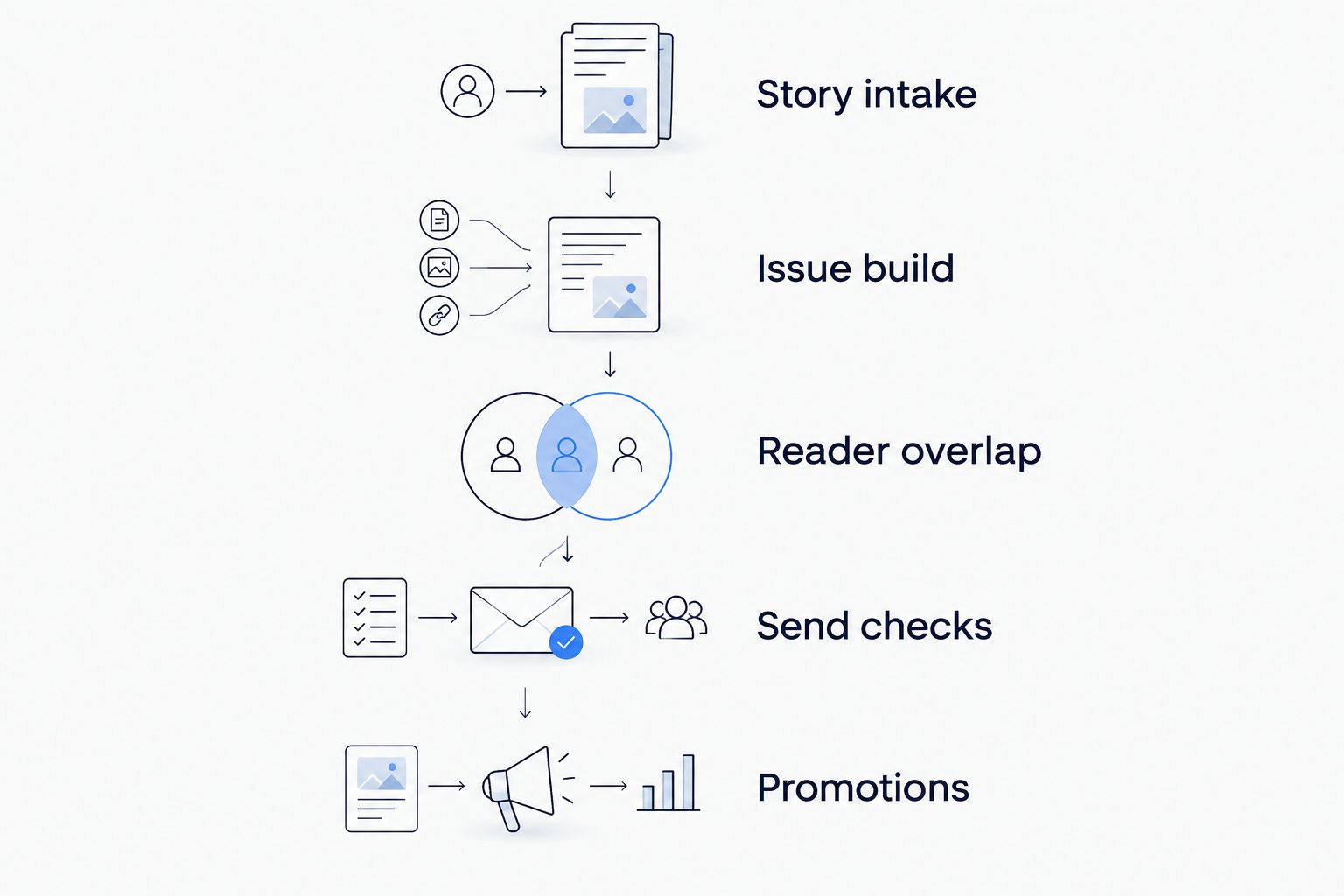
Test a complete publishing workflow, not just the email editor.
Record each result as demonstrated, requires another tool, or unresolved. Don’t turn an unresolved requirement into a promised capability because the rest of the demonstration looked good.
Before approving a switch, assign responsibility for subscription mapping, issue review and the sending transition. Moving platforms means rebuilding sending reputation; plan for IP warming rather than assuming a new sender inherits the old sender’s reputation.
Which newsletter software should you choose?
Choose Letterhead if your trade publication already publishes online and your team needs one place to run several newsletters. Start with a real issue, then test story intake, overlapping subscriptions, send checks and promotions.
Keep Mailchimp when a marketing-led campaign workflow remains the right fit. Choose Ghost when you’re deciding how to publish the website and newsletter together. Choose beehiiv when you’re building an independent newsletter-centered publication.
The practical decision is the amount of publishing work the setup supports—not the length of its feature list.
FAQ
What’s the best newsletter software for trade publications in 2026?
For website-led teams running several newsletters, Letterhead is the strongest fit on this shortlist. Mailchimp fits marketing-led campaigns, Ghost fits website-centered publishing, and beehiiv fits independent newsletter businesses.
Should a trade publication switch from Mailchimp?
Switch when a demonstrated publishing requirement justifies the change. If separate lists and manual copying are the problem, test subscription handling and story intake before committing.
Is Ghost better for a trade publication with a website?
Ghost fits best when website publishing and newsletters are part of the same decision. If your existing website must stay, establish how the proposed setup works alongside it before choosing.
Can one reader subscribe to several newsletters?
Yes, a reader can have several newsletter subscriptions. Check each platform’s subscription model and contact-counting rules rather than treating a subscription and a person as interchangeable.
What should a small newsletter team test first?
Test an actual issue from story selection through final review. Include overlapping subscriptions and a sample promotion so the evaluation covers more than the email editor.
Does switching newsletter software improve deliverability?
A platform switch doesn’t establish better inbox placement. Moving means rebuilding sending reputation, so include IP warming and a sending transition plan in the migration.
What’s one last thing to check?
Write the newsletter’s job before choosing the software: For [reader], this issue helps them [decision or task] through [editorial promise]. Complete that sentence separately for each newsletter.
If your team can’t explain why two newsletters are different, software won’t make the distinction for you.
Related guides
By Letterhead