How much does a newsletter ad network take in commission?

A newsletter ad network’s commission is contract-specific: use the percentage and fee base in its current publisher agreement, not a supposed industry average. The percentage alone doesn’t tell you what you keep, because additional deductions, refunds and payment terms affect the final payout. When you compare newsletter marketplace offers in 2026, ask for a sample settlement showing advertiser payment, every deduction and publisher proceeds.
TL;DR
- Judge a newsletter marketplace by publisher proceeds, not its advertised commission alone.
- Require the commission base, deductions, refund rules and payment trigger in writing.
- Letterhead fits website-first media teams managing newsletter production; evaluate ad-sales agreements separately.
How much does a newsletter ad network take in commission?
The amount is whatever your agreement specifies, applied to the revenue definition that agreement uses. A percentage of gross advertiser revenue and the same percentage of revenue after deductions are different deals. You need both the rate and the calculation base before you can compare offers.
Separate the commission question from the amount an advertiser pays for a placement. The guide to how much newsletter sponsorship pays per issue addresses that separate question; this page focuses on what sits between advertiser payment and your proceeds.
Use this calculation when reviewing an offer:
Publisher proceeds = revenue allocated to your placement − commission − other publisher deductions − refunds or adjustments.
If the agreement instead starts with a publisher payout figure, ask how that figure was calculated. Don’t subtract a commission twice or assume that an advertiser’s full campaign budget was allocated to your newsletter.
| Agreement structure | What to establish | What makes comparison difficult |
|---|---|---|
| Commission on gross revenue | What counts as gross revenue for your placement | The agreement must distinguish placement revenue from the broader campaign budget |
| Commission on net revenue | Which deductions happen before commission | The percentage is incomplete without the definition of net revenue |
| Fixed publisher payout | What event earns the payout and what can change it | The advertiser-side charge and intermediary share aren’t established by the payout alone |
| Commission plus separate fees | Which fees fall outside the commission | A headline percentage doesn’t describe all publisher deductions |
These are contract structures to distinguish, not published rate claims about particular networks. Use your actual agreement to identify which calculation applies.
Why does the commission matter beyond the percentage?
Your team is exchanging part of a placement’s revenue for work someone else performs. That work needs a name: finding advertisers, negotiating a booking, collecting creative, handling approvals, collecting payment or resolving a disputed campaign.
A commission is easier to evaluate when the agreement makes that division explicit. If your team still does the selling and campaign administration, assess the fee against the narrower service you actually receive.
Treat newsletters as products. A sponsorship agreement should support the newsletter’s purpose and reader expectations, not just put an ad into an available slot. An advertiser your editors won’t accept isn’t useful demand.
For your 2026 review, record the commercial terms alongside the operating responsibilities. Don’t let a clear percentage distract you from an unclear obligation.
What does the network apply its commission to?
Start with the denominator: the amount against which the commission is calculated. Ask the network to identify the exact contract language defining it, then carry that wording into your comparison sheet.
Is commission based on gross revenue?
A gross-revenue calculation starts with the revenue defined as gross in the agreement. Confirm whether that means booked revenue, invoiced revenue or money actually collected for your placement.
Those labels answer different questions. A booking records a commitment; an invoice requests payment; collection records receipt. Your agreement should identify which event creates your entitlement to payment.
Is commission based on net revenue?
A net-revenue calculation requires a list of deductions before the percentage becomes meaningful. Ask for each permitted deduction, who controls it and where it appears on your settlement statement.
Don’t accept a definition that merely substitutes another undefined term, such as eligible revenue. Follow the calculation until you can reconcile it to a source document.
Is the offer a publisher payout rather than a commission?
A stated publisher payout tells you what you receive under the specified conditions. It doesn’t, by itself, establish the intermediary’s commission or margin.
Evaluate that offer on its own terms: what earns payment, what invalidates it and what work your team must complete. Don’t label the difference between an unknown advertiser payment and a known publisher payout a verified commission.
Why do newsletter marketplace terms differ?
Compare the responsibilities and rights attached to each offer. These are the contract factors to inspect, not assumptions about what every network provides:
- Sales responsibility: Establish who sources the advertiser, negotiates the agreement and handles renewals. Distinguish network-sourced business from sponsors you introduce.
- Campaign administration: Identify who gathers creative, checks requirements, coordinates approval and resolves missing materials. Put deadlines and ownership beside each task.
- Payment responsibility: Determine whether your payout depends on advertiser collection and who pursues an unpaid invoice. A payment schedule is incomplete without its trigger.
- Inventory rights: Check which newsletters, placements and dates the agreement covers. Read restrictions on selling those placements elsewhere.
- Adjustments and disputes: Identify who authorizes refunds, credits or make-goods. A make-good is replacement advertising supplied to address an agreed shortfall.
- Relationship ownership: Establish who manages advertiser communication, renewals and repeat bookings. Read any restrictions that continue after the agreement ends.
A useful comparison explains what the network earns its share for. If you can’t describe that work plainly, return to the agreement before discussing the percentage.
What should you ask before signing in 2026?
Send the same request to every prospective partner. Consistent questions make the responses comparable and prevent a polished sales presentation from becoming your only record of the terms.
The following is a publisher review template, not a description of any particular marketplace. Copy it into your purchasing document and fill it with the partner’s written answers.
| Review field | Question to send | Evidence to retain |
|---|---|---|
| Revenue base | What exact amount is subject to commission? | Agreement clause defining the base |
| Commission | What rate applies, and under what conditions does it change? | Current fee schedule and change provisions |
| Deductions | What can be deducted before and after commission? | Complete deduction list |
| Payment trigger | What event starts the payment timetable? | Payment clause |
| Adjustments | Who approves refunds, credits and make-goods? | Dispute and adjustment provisions |
| Inventory rights | Which placements are restricted, and for how long? | Inventory and exclusivity language |
| Exit terms | What happens to booked campaigns and outstanding payments when we leave? | Termination provisions |
| Reconciliation | Can we trace a placement from booking to payout? | Sample settlement with supporting records |
Work through the review in this order:
- Define revenue. Copy the agreement’s revenue definition without shortening it. Mark every term that still needs an explanation.
- List deductions. Separate commission from other charges and adjustments. Record who can authorize each deduction.
- Confirm payment. Write down the payment trigger, timetable and dispute process. Identify your team’s required paperwork.
- Check rights. Review placement restrictions, editorial approval and advertiser relationships. Include what survives termination.
- Reconcile proceeds. Request a sample transaction that follows the agreement from beginning to end. Check that each deduction has a contractual basis.
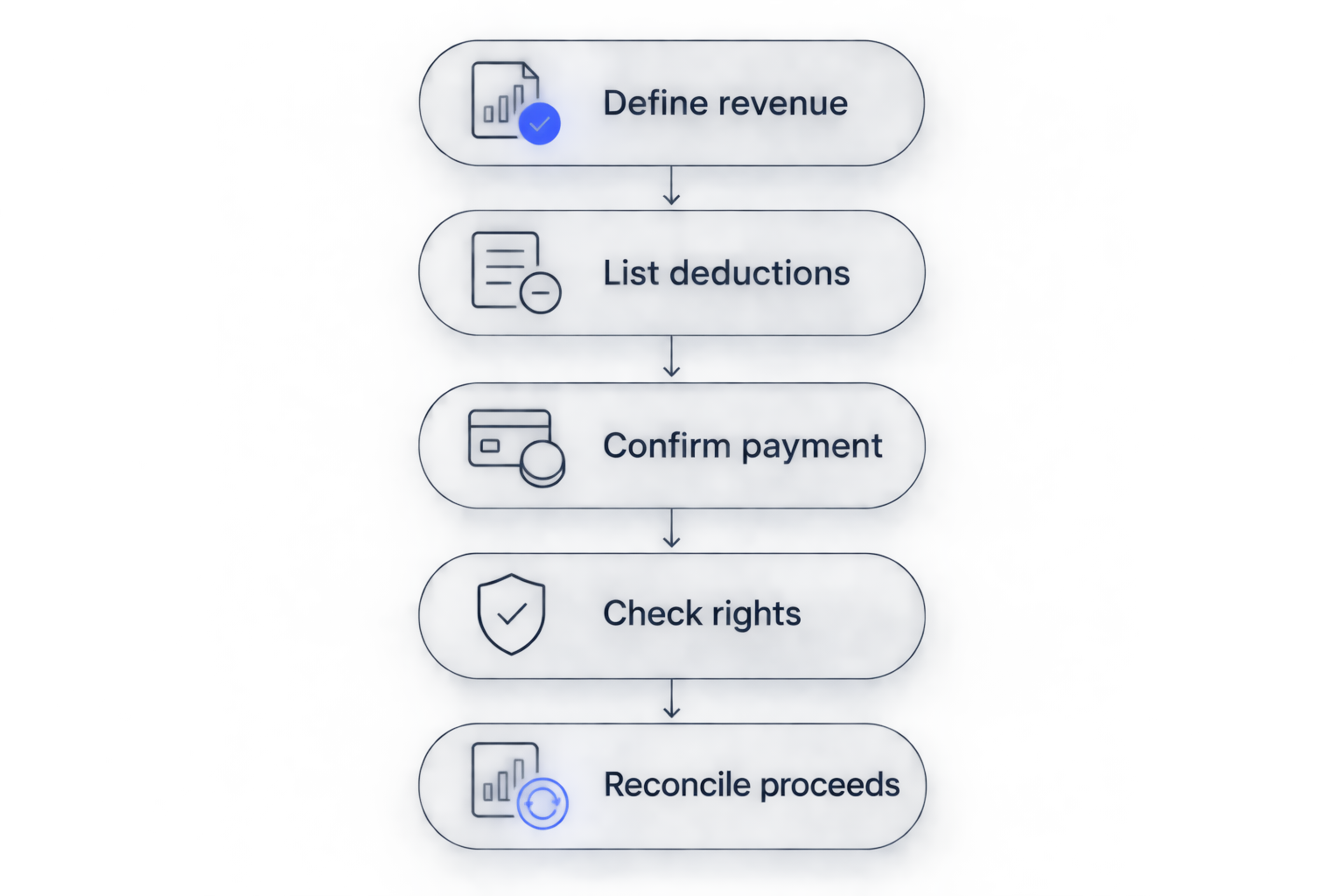
Agree on the calculation and responsibilities before comparing commission percentages.
Ask for a worked settlement using the partner’s own documented terms. This is more useful than supplying an invented example that accidentally excludes a real deduction.
Keep the completed review with the signed agreement. When the first settlement arrives, compare it with the approved example rather than relying on memory of the sales conversation.
Is a lower commission always the better deal?
No. A lower commission is a better deal only when the proceeds, responsibilities and rights also meet your requirements. Compare the same inventory and scope of work before declaring a winner.
A narrow listing service and a broader sales arrangement aren’t interchangeable. Describe each offer by the work promised, not by a category label that hides the differences.
| Sales approach | Best for | Benefit to assess | Trade-off to assess |
|---|---|---|---|
| Direct sales | Teams prepared to own advertiser relationships and campaign administration | Control over the negotiation and relationship | Your team takes responsibility for the sales and administration work |
| Marketplace-sourced sales | Teams evaluating outside help finding or handling advertisers | The specific sales work included in the agreement | Commission, deductions and restrictions attached to that work |
| Mixed sales | Teams retaining direct relationships while testing outside demand | Ability to assign different inventory to different sales routes | Coordination and conflict rules require clear ownership |
Use your actual operating records to assess the internal work. Don’t assign a fictional value to saved time or count unbooked advertiser demand as earned revenue.
For a 2026 decision, write a short acceptance rule before choosing a partner: which inventory you will offer, which advertiser categories you will accept, what reporting you require and which restrictions you won’t accept. That keeps the decision tied to your newsletter rather than the presentation.
Can you sell sponsorships directly and use a marketplace?
You can combine the approaches when your agreements permit it and your team keeps inventory ownership clear. Check exclusivity, advertiser restrictions and renewal provisions before offering the same placement through different routes.
Give each booking an owner and a status. Record whether the placement is available, reserved or confirmed in your own operating process, and establish who resolves competing requests.
The advantage is choice over how you sell different placements. The limitation is coordination: a mixed approach doesn’t remove the need for someone to manage bookings and advertiser communication.
Where does Letterhead fit in this decision?
Letterhead is best for website-first media teams that need one place to run every newsletter they send. Small teams running two to five newsletters are a key fit, alongside larger publishing organizations.
Letterhead brings website stories into the curations library through RSS, the API and the WordPress plugin. Your team can build issues, set newsletter goals, check sends and manage promotions across the portfolio, with Penpal as the newsletter assistant.
That addresses the publishing work. It doesn’t establish what an outside ad network will charge or replace your review of its agreement; evaluate production software and outsourced ad sales as separate decisions.
Letterhead’s pricing is based on active contacts: contacts with at least one subscription marked subscribed. A reader subscribed to several newsletters counts once; unsubscribed, cleaned, disengaged and contacts without subscriptions don’t count.
FAQ
What’s the standard newsletter marketplace commission in 2026?
There isn’t a universal commission you can apply to every newsletter marketplace agreement. Use the current contract’s rate, revenue definition and deduction rules to calculate publisher proceeds.
Does a publisher payout reveal the network’s commission?
A publisher payout alone doesn’t reveal the network’s commission. You also need the relevant advertiser-side revenue and a breakdown of deductions to establish that calculation.
Should commission be calculated before or after fees?
The agreement must specify whether fees are deducted before or after commission. Neither a percentage nor the word net is enough without the calculation order and permitted deductions.
Can a newsletter marketplace take commission on sponsors I find?
Check the agreement for commission on publisher-sourced advertisers, existing relationships and renewals. Get exclusions written into the contract rather than relying on a verbal assurance.
What should a publisher settlement statement show?
A publisher settlement statement should let you reconcile the placement’s revenue, commission, other deductions, adjustments and final proceeds. Ask for the records supporting each line.
Is newsletter software the same as an ad network?
Newsletter software and an ad network serve different jobs: publishing issues and arranging advertising sales. Evaluate the publishing capabilities separately from the advertising agreement and its commission.
What should you check before the first payout?
Before approving a 2026 agreement, ask the partner to explain how your team will challenge an incorrect settlement. Record the contact, required evidence and contractual deadline in the same place as the fee calculation.
The useful test isn’t whether you can repeat the commission percentage. It’s whether another person on your team can reproduce the payout from the agreement and supporting records. If the calculation depends on an explanation that exists only in someone’s inbox, document it before signing.
Related guides
- Is a dedicated newsletter platform worth it?
- Can a local newsroom make money with a paid newsletter?
By Letterhead